
WORKING WITH US
Working with organisations as they evolve.
We engage not through predefined solutions, but by working on the conditions under which organisations remain coherent as they adapt.
WHERE WE ENGAGE
We typically work with organisations that are functioning — often performing well — but experiencing increasing complexity, growth, or transition.
The question is rarely whether something is broken.
More often, it is whether the organisation can maintain coherence as conditions change.
This may take different forms: strategy that does not translate into coordinated action; decisions that require repeated alignment; structures that no longer support how the organisation operates; increasing coordination effort without corresponding clarity.
These are not signs of failure. They are structural consequences of evolution.
We work primarily with executive leadership, owner-led organisations in transition, governance bodies, and partners in academic and educational contexts.
No predefined solutions. Methodological rigour.
THE NATURE OF THE WORK
Every organisation develops under its own conditions. We do not apply predefined solutions or standard programmes.
No two organisations evolve in the same way. Their structures, histories, and environments shape how they function — and how they can change.
What remains constant is the intervention logic — developed through our work on systemic resilience, and grounded in both systems-theoretical research and applied experience — through which we observe the system, identify leverage points, and work on the conditions for coherent evolution.
The form of the work is not predefined. It emerges from the organisation itself — shaped by its structure, its history, and its current challenges.
The rigour lies in how the work is developed: in how the system is understood, where intervention becomes possible, and how change is introduced without disrupting what already holds.
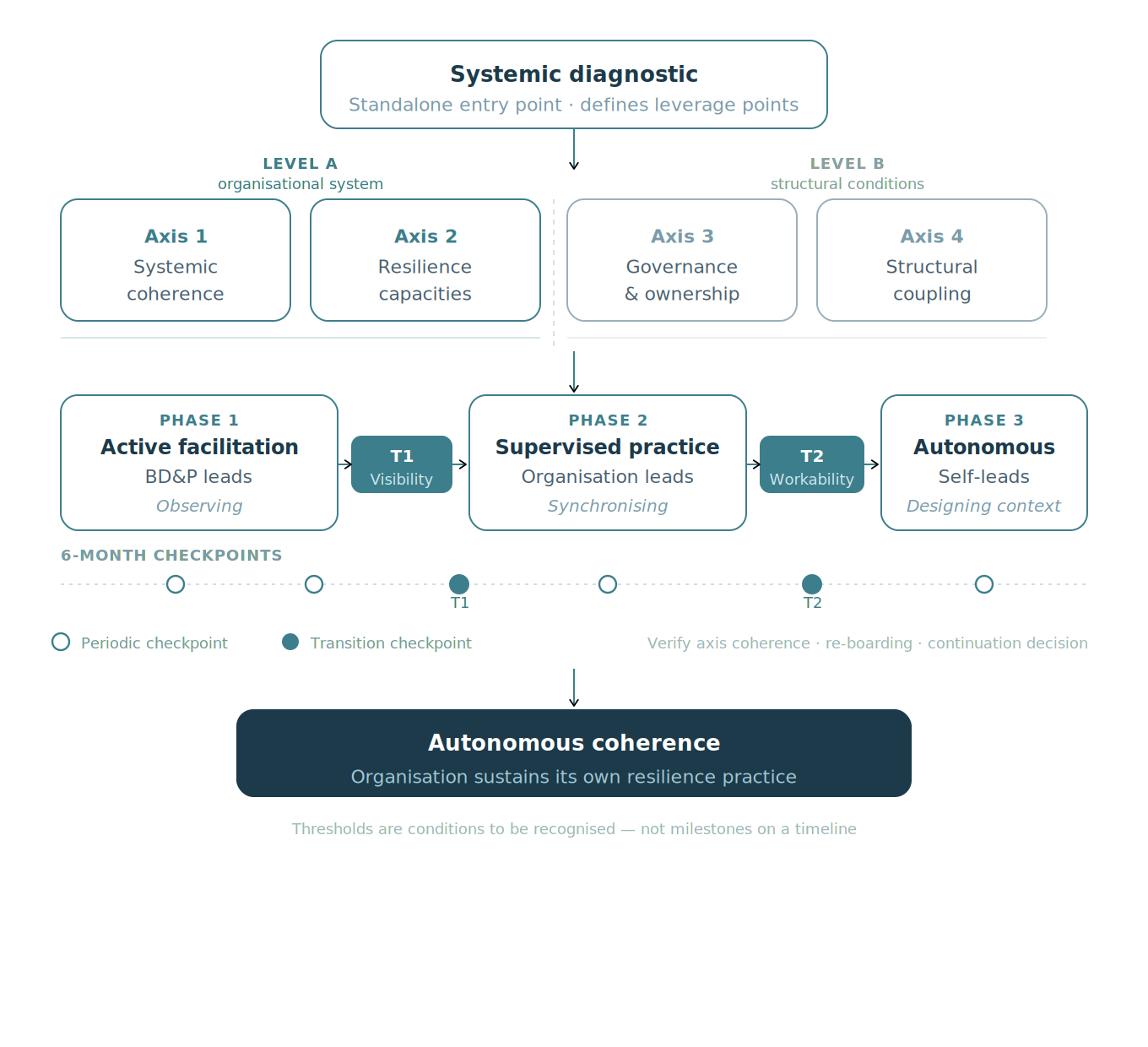
WHAT TO EXPECT
This work is not a short-term intervention. It is a way of engaging with how organisations evolve.
Long-term
Structural coherence develops over time — through the accumulation of decisions, not isolated actions.
Minimally invasive
Every intervention affects the system. We work carefully — strengthening existing structures rather than replacing them.
Co-created
An organisation can only develop from within. Our role is to work with the system — not on it from the outside.
We do not take over steering. We work on the conditions that make steering possible.
The objective is not dependency — but increasing autonomy over time.
HOW IT BEGINS
Each engagement is shaped by the organisation itself. In practice, the work typically combines three elements.
Systemic diagnostic
A shared understanding of how the organisation currently operates — where coherence holds, and where it does not.
Structured intervention
Working on the conditions that enable coherent evolution — across strategy, structure, decision-making, and governance.
External perspective
Observing the process itself — maintaining an external perspective on how the system works and how the intervention unfolds, adjusting focus, pace, and direction as the system evolves.
Every engagement starts with the diagnostic. This is a clearly defined, standalone piece of work — creating orientation around how the system functions, where structural tensions exist, and where development is possible.
The purpose is not to define a project. It is to understand the system.
A longer engagement is not assumed. It emerges from clarity.
THE OBJECTIVE
The objective is not to deliver change from the outside.
It is to enable the organisation to understand its own functioning, address structural misalignments, and maintain coherence as it evolves.
Over time, the work shifts — from external support to internal capability, and ultimately to autonomous operation. We step back as the organisation develops the capacity to carry the work itself.
The first step is a conversation.
The second is a shared understanding.
The aim is to understand the system.