
THE FIELD
Organisations maintain themselves through communication, decisions, and coordinated action.
Their coherence — the alignment between what they are, where they are going, and how they operate — is what makes purposeful action possible.
That coherence is always under pressure. As conditions change, as organisations grow, as strategies evolve and structures adapt, the interactions between an organisation's fundamental functions become more complex, more demanding, and more consequential. Maintaining coherence under these conditions is one of the defining challenges of organisational life.
THE CHALLENGE
A structural tension that cannot be resolved — only navigated.
Organisations must remain stable enough to coordinate action. And they must remain adaptive enough to evolve as their environment changes. Neither stability nor adaptability alone is sufficient. What matters is the capacity to remain coherent enough to act — and open enough to adapt without losing the coherence that makes action meaningful.
This is the terrain of systemic resilience.
SYSTEMIC RESILIENCE
The ongoing organisational capacity to maintain coherence while continuously adapting.
Systemic resilience is a structural capability — one that emerges from the quality of interaction between an organisation's fundamental functions, and from the organisation's ability to observe, align, and reshape those interactions over time.
It is also a temporal practice. Systemic resilience must be continuously reproduced — developed, anchored, and sustained through the cycles of challenge and adaptation that organisational life inevitably produces. Certain conditions are required for this reproduction to hold: sufficient stability to make change absorbable, trust as a structural condition for transformation, and the organisational capacity to pace change in ways that respect absorptive limits.
An organisation with strong systemic resilience maintains the capacity to process disruption without losing coherence — and to develop that capacity deliberately over time.
WHAT THIS MAKES POSSIBLE
Systemic resilience becomes visible in how organisations operate.
Decisions align across levels. Strategy translates into coordinated action. Structures support how the organisation actually works. Adaptation happens without loss of coherence.
These are not outcomes that can be implemented — they are effects that emerge from how the system functions.
WHAT THIS LOOKS LIKE IN PRACTICE
These effects become observable as recurring patterns in everyday organizational life.
The patterns are recognisable — and often familiar.
Strategic decisions are made but not enacted. Priorities are declared but do not translate into coordinated action.
Structures exist but are bypassed through informal channels. Tensions recur in different forms despite repeated attempts to address them. Transformations that appear successful in the short term gradually revert.
What appears as isolated issues is, in fact, the expression of consistent patterns of interaction.
Most organisations encounter these situations.
What is less obvious is why they persist — and where they originate.
These patterns share a common source: the interactions between the organisation’s fundamental functions have become misaligned. The system is straining — not from external pressure alone, but from internal incoherence.
To understand this, organisations need to be observed differently.
Not as collections of functions, but as systems.
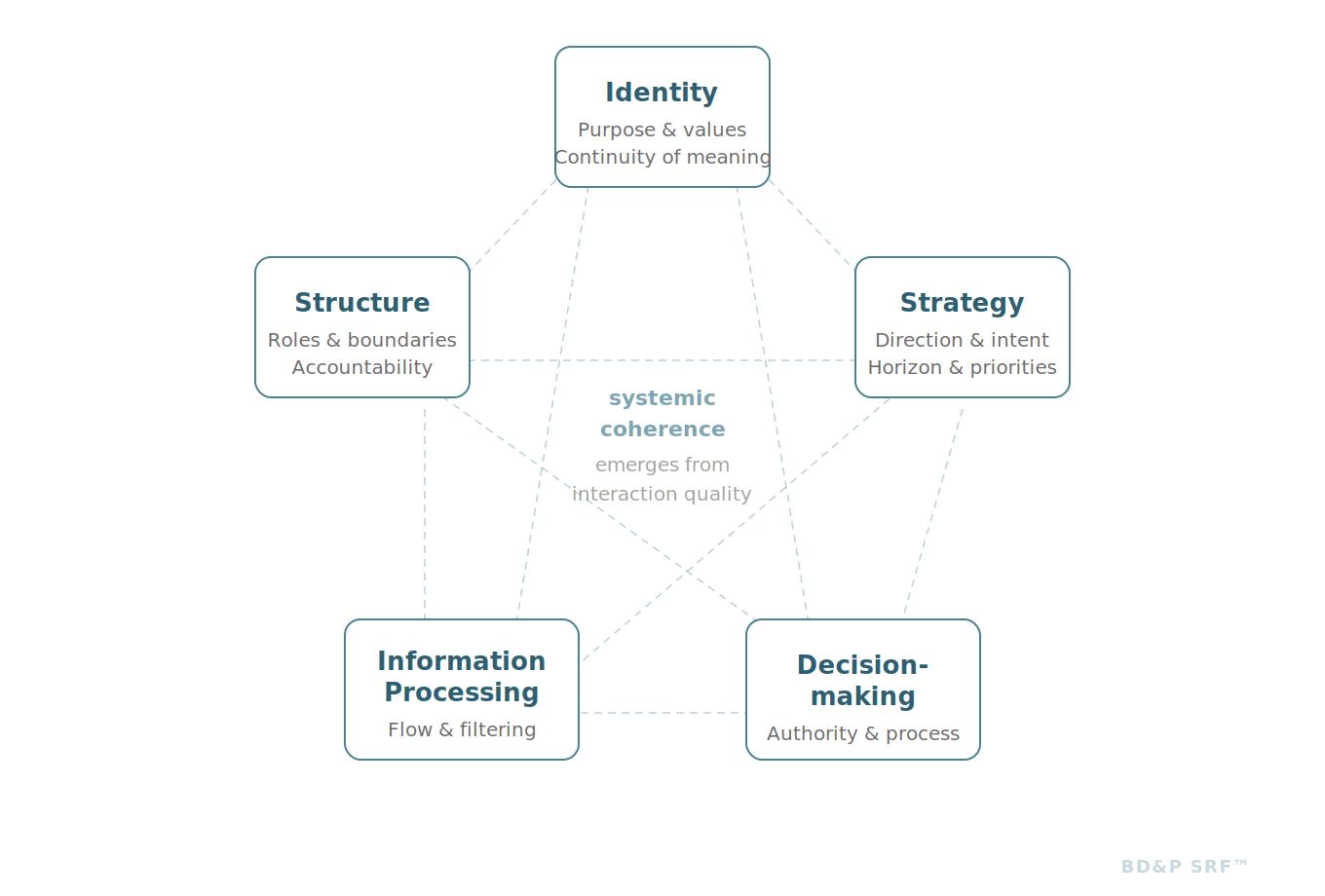
Seen this way, organisational coherence emerges from a small set of fundamental functions — and from how they are connected in practice.
In systemic terms, these recurring patterns are the organisation’s connectors: the communication patterns through which identity, strategy, structure, information, and decision-making are linked.
THE FIVE SYSTEMIC PILLARS
The fundamental functions through which organisations maintain coherence.
These pillars describe the fundamental functions through which organisations maintain coherence.
They are not departments, roles, or processes — they are the underlying functions through which the organisation continuously reproduces itself as a coherent system. None is prior to the others. Each depends on, and continuously shapes, the other four.
But these functions alone do not ensure coherence. What matters is the quality of their interaction in practice.
SYSTEMIC CONNECTORS
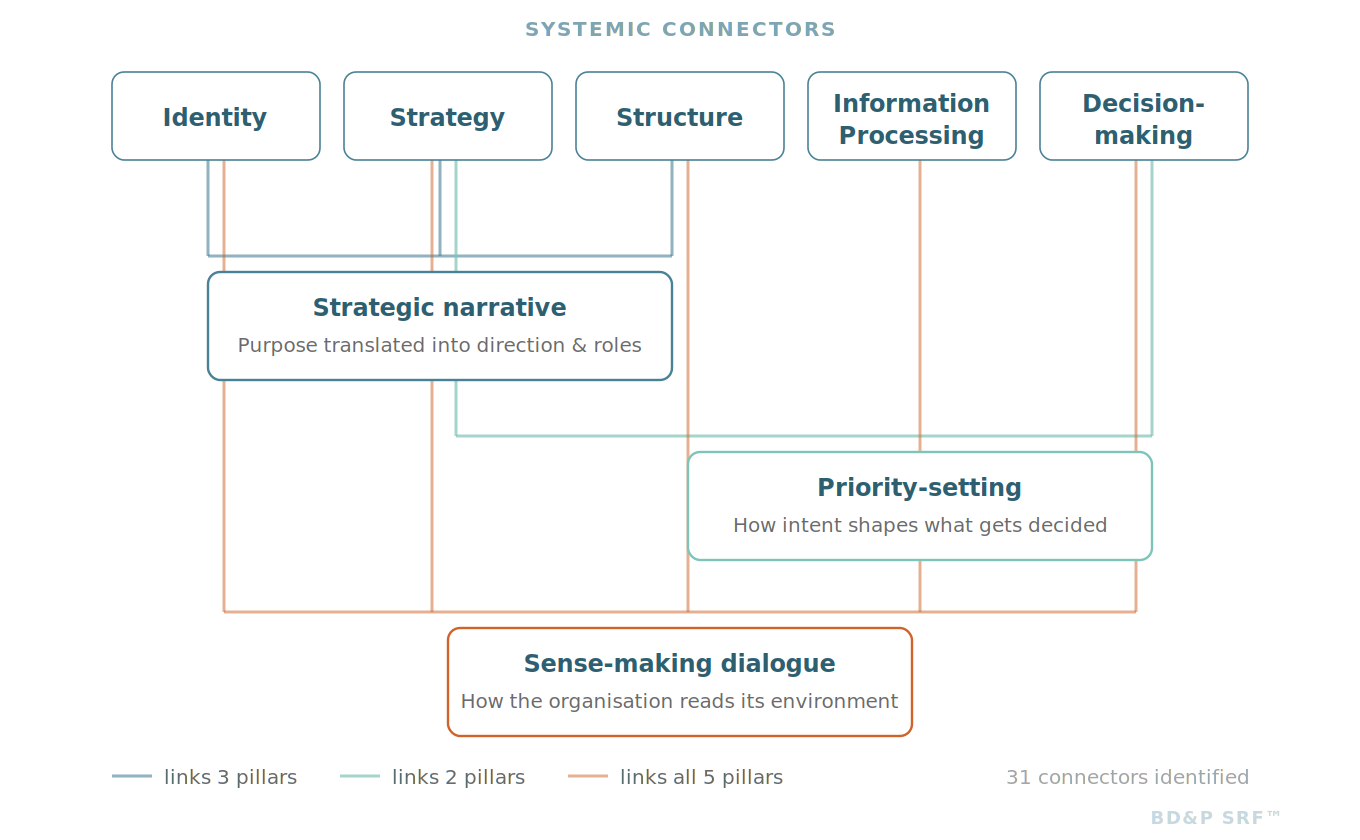
The recurring communication patterns through which the pillars interact in everyday organisational life.
The pillars do not interact in the abstract. They interact through concrete, observable communication patterns — the recurring practices through which priorities are set, decisions are communicated, responsibilities are clarified, and the organisation reflects on its own functioning. BD&P has identified 31 such connectors. They are the operational interface through which systemic coherence becomes visible — and designable.
RESILIENCE CAPACITIES
The second-order capabilities that allow an organisation to work on its own functioning.
The five pillars and their connectors describe how an organisation functions. But functioning alone does not guarantee coherence over time. As conditions shift, priorities drift, structures become misaligned, and decision-making loses effectiveness.
BD&P's framework identifies three capacities that allow the organisation to work on itself — not from within the system, but on it.
Observing
Developing the capacity to see how the system functions as a whole — including blind spots, distortions, and the gaps between what is intended and what is actually occurring.
Synchronising
Recognising and addressing misalignments between systemic functions — ensuring that identity, strategy, structure, information processing, and decision-making remain coherent in their interaction.
Designing
the Context
Shaping the conditions under which the organisation coordinates, reflects, and evolves — creating the environments in which coherence can be maintained and development can occur.
These capacities do not operate within the system — they operate on it.
SYSTEMIC EVOLUTION
Resilience is not a state to be reached. It is the continuous capacity to process change without losing coherence.
As conditions change, the interactions between an organisation’s fundamental functions do not remain stable. They shift.
This change does not unfold linearly, but through recurring cycles. Each cycle begins with an irritation — a signal that existing patterns are no longer adequate to the conditions. That irritation, when processed well, triggers observation, then adjustment, then a new stabilisation.
BD&P's framework makes this cycle explicit and names the conditions that determine whether an organisation can navigate it productively.
It does so by strengthening the organisation’s capacity to observe, to realign, and to shape the conditions under which it evolves.
Irritation is not dysfunction
In systems theory, irritation is a productive signal — the moment at which the organisation recognises that its current patterns are insufficient for new conditions. How the organisation responds to that signal determines whether it evolves or fragments.
Three enabling conditions
For evolution to remain coherent, three structural conditions must be in place: stability — sufficient coherence to make change absorbable; trust — the structural condition that enables movement without fragmentation; and absorptive capacity — the organisation's ability to integrate change at the right pace.
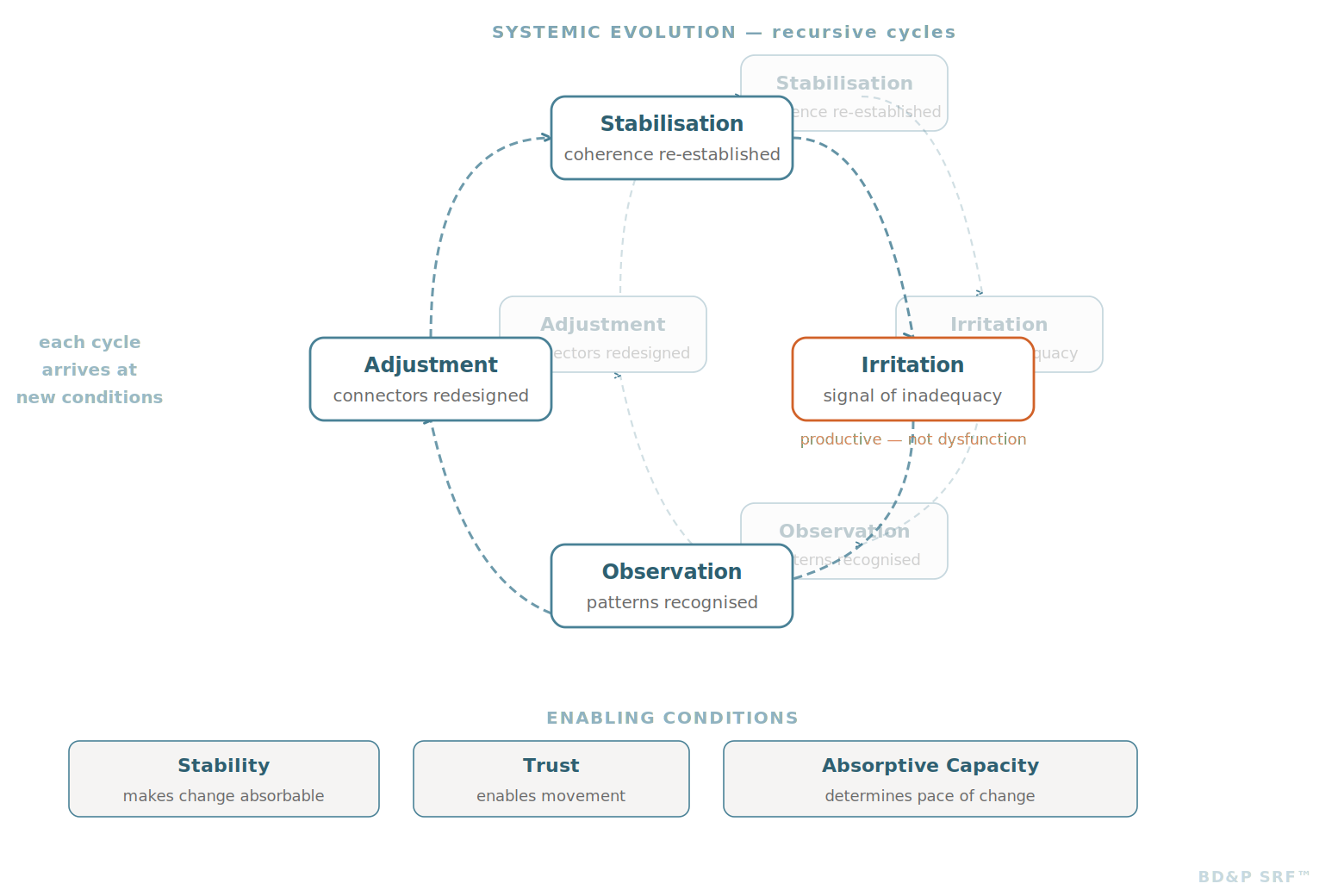
These are not soft cultural factors. They are structural conditions — observable, assessable, and developable through systemic work.
THE SYSTEM CONSTELLATION
An organisation's resilience is shaped not only by its internal coherence — but by the broader constellation of systems in which it operates.
Most frameworks stop at the organisation's boundary. BD&P's does not. Organisations operate within broader constellations of structurally coupled systems — governance bodies, ownership structures, and the individuals who hold positions of influence. The functioning of each shapes what the organisation can and cannot do.
In many organisations, the most consequential constraints on resilience do not originate within the organisation itself. They are rooted in the compatibility — or incompatibility — between these structurally coupled systems.
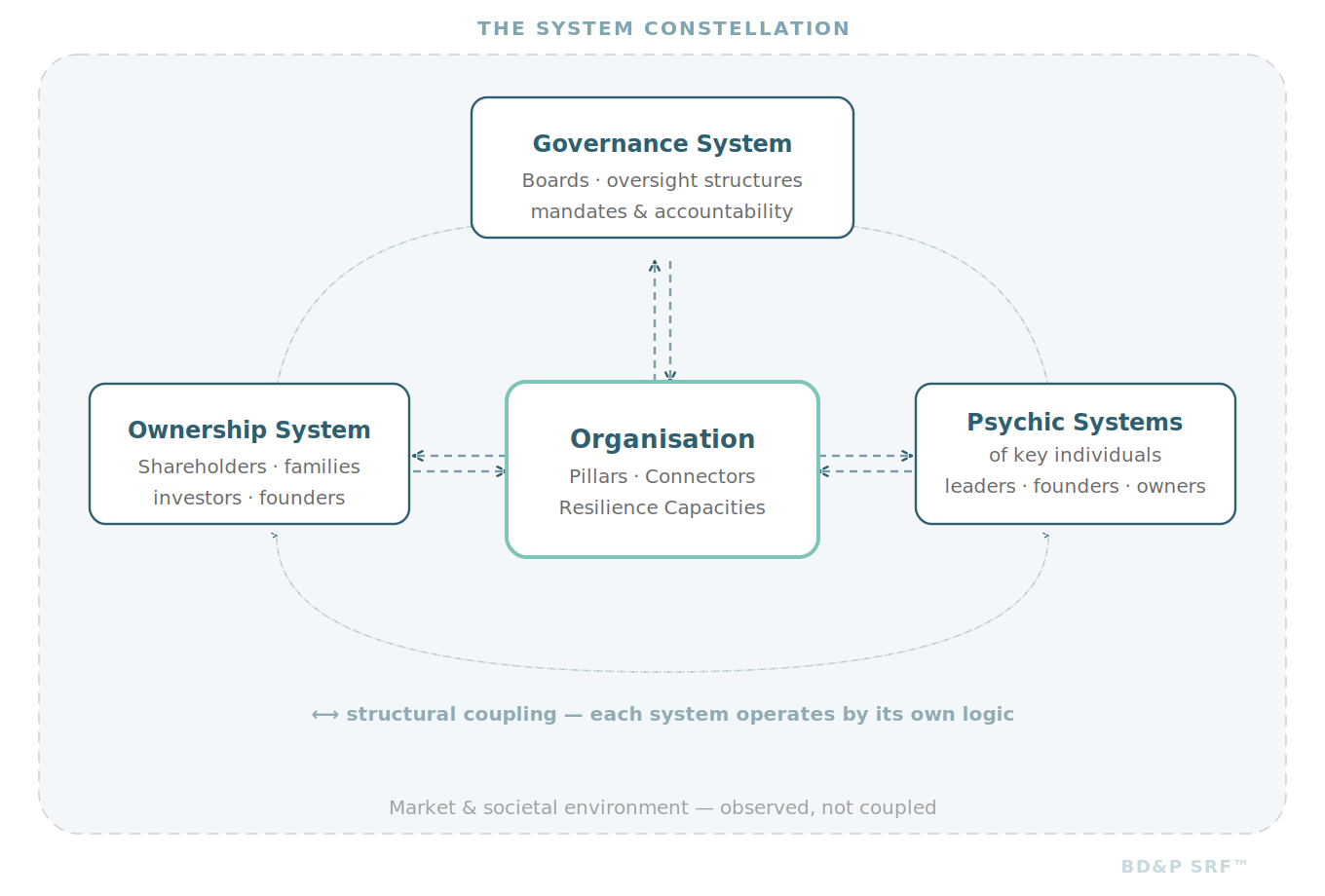
These systems do not merge. Each operates according to its own logic. But they are structurally coupled — their operations continuously shape one another. The quality of that coupling determines whether the constellation amplifies or constrains the organisation's development.
This perspective is particularly relevant in founder-led organisations, family businesses, governance-heavy environments, and organisations navigating leadership transitions.